
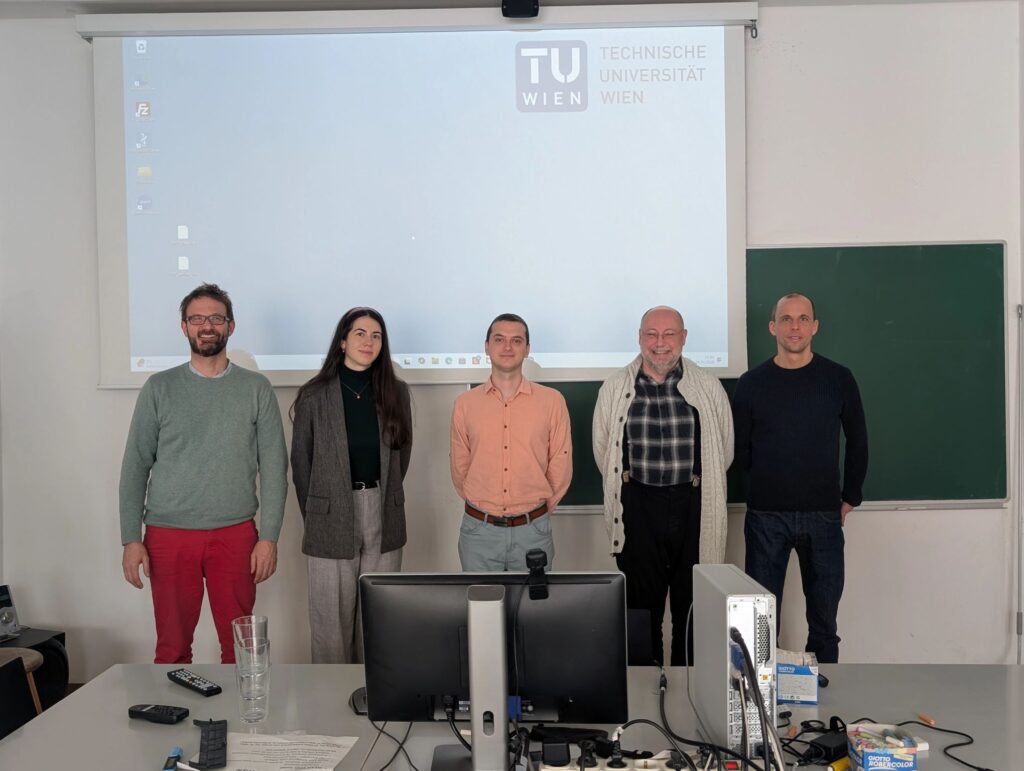
In the period 25-28 January 2026, our colleagues Slavcho Neshev and Monika Velichkova had the opportunity to take part in a short-term research visit focused on identifying promising directions for joint research and future publications. The visit was carried out within the framework of the ENCORE-6G project, representing the Faculty of Telecommunications, Technical University of Sofia, during their stay at Technische Universität Wien.
They were warmly welcomed by Markus Rupp, Stefan Schwarz, and Philipp Svoboda. During a joint meeting between the teams, Slavcho and Monika introduced their academic backgrounds, ongoing research activities, and long-term research vision. This initial exchange proved highly valuable, helping both sides identify common interests and potential areas for collaboration. They also attended several insightful presentations on beam management techniques, which sparked engaging discussions and provided valuable context for future joint work.
Following the joint sessions, Slavcho had more focused technical discussions with Stefan Schwarz and Philipp Svoboda, where they began shaping the core concept of future collaboration. A central topic was how to connect semantic understanding of 3D scenes with wireless communications. In particular, the discussions explored how object-level 3D scene segmentation could serve as additional side information for beamforming, enabling more object-centric communication strategies. This included identifying and prioritizing critical devices or objects with specific QoS requirements, guiding beamforming decisions using semantic information rather than relying solely on geometric or signal-based criteria, and considering future extensions toward supporting non-line-of-sight devices with the help of RIS.
They also had the opportunity to meet with Dr. Robert Langwieser and Florian Asperger, where the discussion focused on the use of 26 GHz measurement data as an additional information source. In this context, they explored how features such as AoA, AoD, received signal strength, and beam angles could be used to semantically identify dominant scatterers in the environment and classify room or scene types. Such information could support the estimation of electromagnetic statistics and potentially enable faster decision-making for transmitter placement and coverage optimization.
This visit was one of several planned short-term exchanges within the ENCORE-6G project, and it was a highly valuable experience for both colleagues. It helped clarify a number of important concepts and created an excellent foundation for future collaboration. The opportunity to discuss ideas in depth with such experienced researchers was both motivating and inspiring.
We are confident that this collaboration will lead to strong results and meaningful joint publications.
Looking forward to the next steps 🚀