
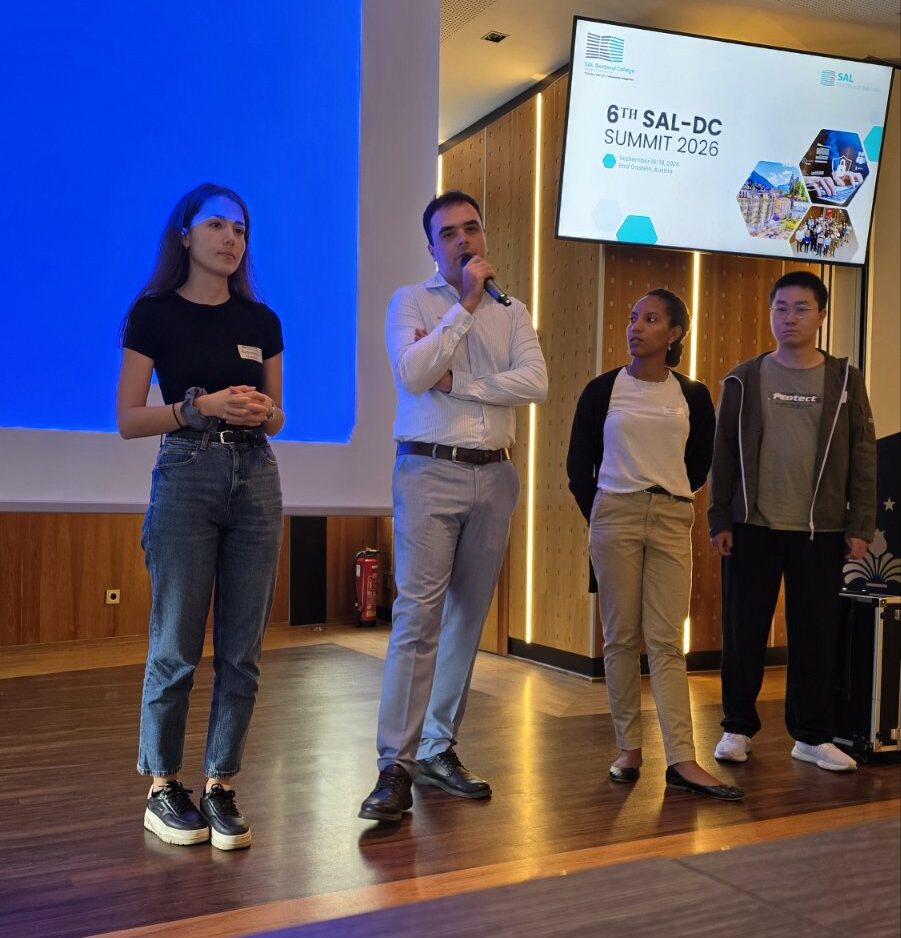
We are pleased to highlight the participation of three researchers from our team in the 5th Summit of the Silicon Austria Labs – Doctoral College (SAL-DC), where they presented research covering AI-based sensing, holographic-type communications, and deep-learning approaches for 3D content coding and transmission.
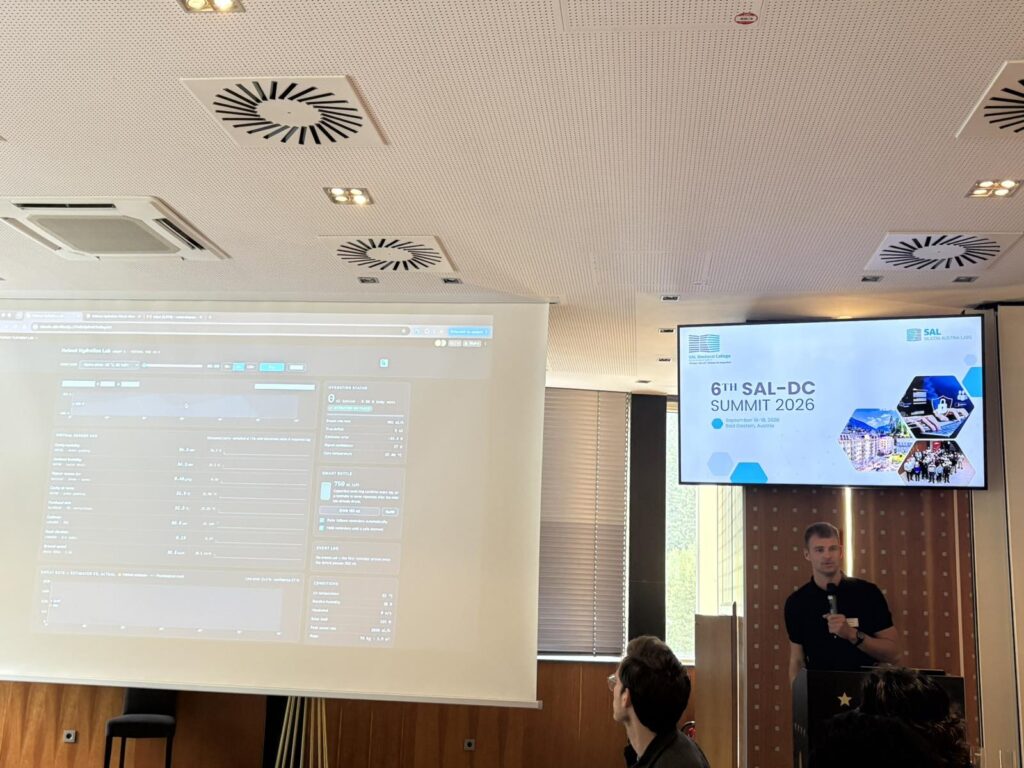
🔹 Rumen Doynov presented work related to the evaluation of multiple AI models using a common set of sensor data. The data were collected through a smart sensing system integrated into a cycling helmet and an intelligent water bottle. By deploying different AI models on identical inputs, the work focuses on comparing their accuracy, consistency, and reliability of the resulting decisions, providing a common basis for evaluating AI-based approaches in smart sensing applications.
🔹 Radostina Petkova presented the poster “Methods and Algorithms for Implementing Holographic-Type Communication.” Her research addresses some of the fundamental challenges of holographic-type communications, where extremely high data rates, minimal latency, computational efficiency, and strict synchronization are key requirements.
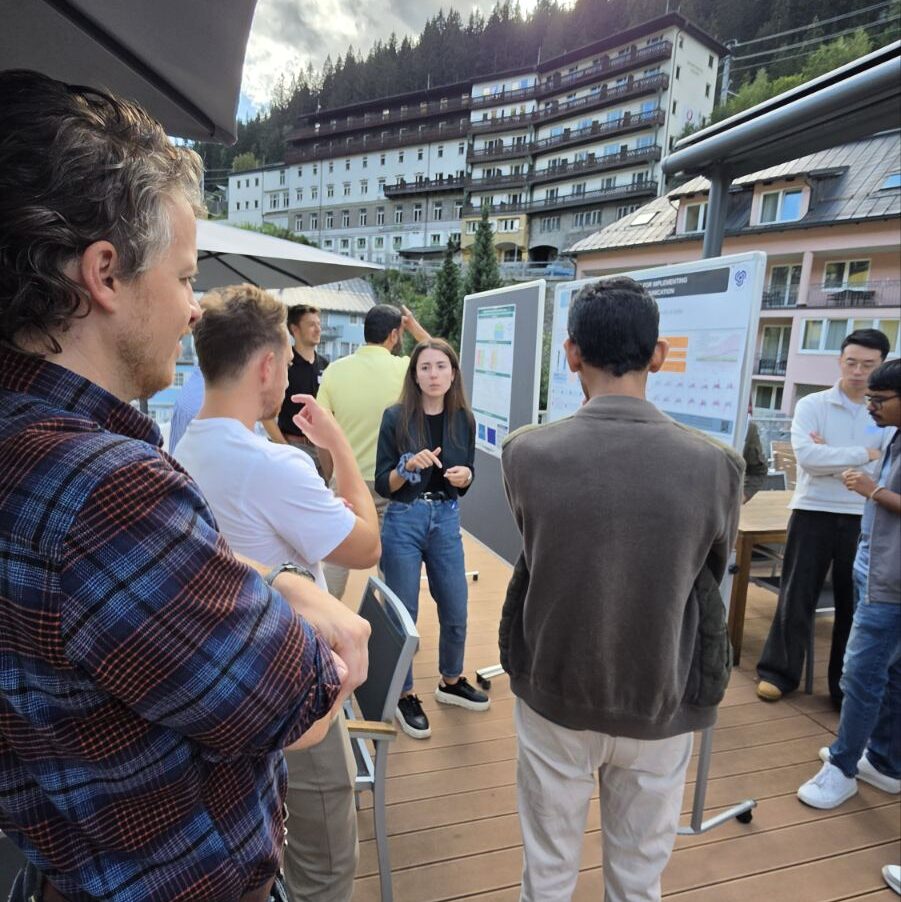
The presented methods focus particularly on multi-view point cloud registration and compression. The research investigates learning-based approaches for registering correlated views and explores efficient compression of multi-view point clouds, including distributed compression with decoder-side information. These methods target more efficient representation and transmission of the large volumes of 3D data required by future holographic communication systems.
🔹 Ivaylo Bozhilov presented the poster “Coding and Visualization of 3D Content Using Deep Learning Architectures.” His work explores how learning-based representations can improve the efficiency of coding and transmitting complex 3D content.
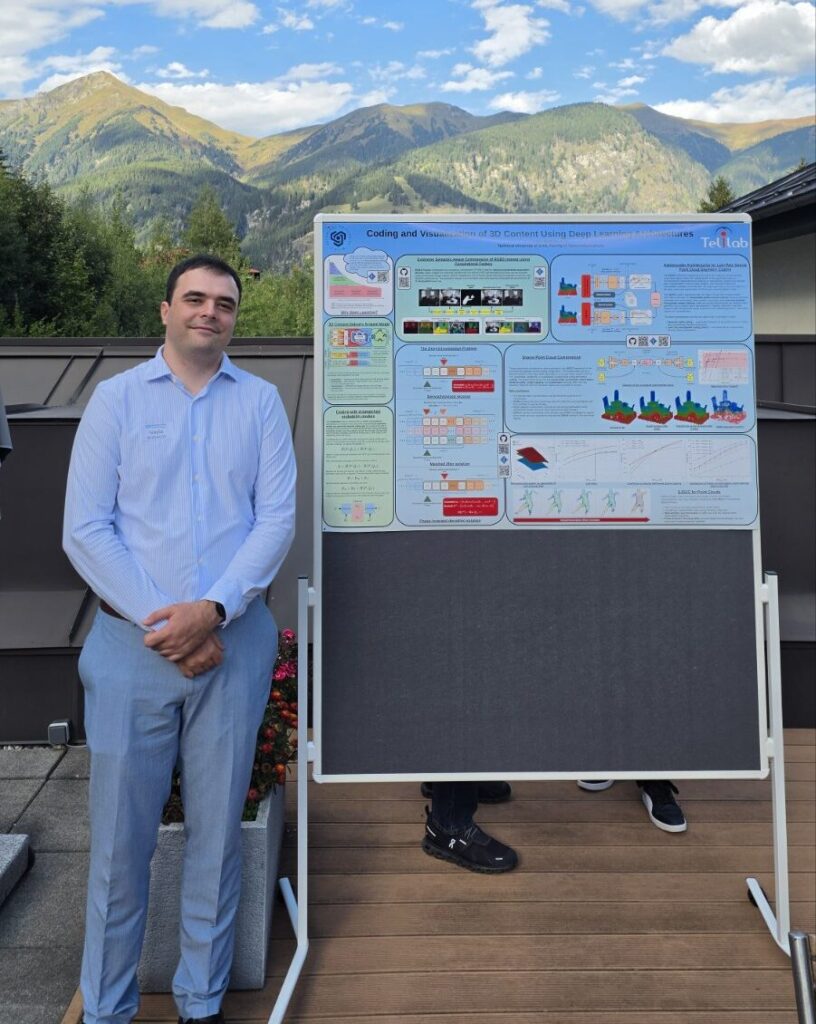
The presented research covers several complementary directions, including semantic-aware compression of RGB-D data, where depth information is transformed and combined with conventional image coding techniques to reduce communication load while maintaining low processing requirements at the acquisition side.
Another research direction investigates autoencoder architectures for low-rate sparse point-cloud geometry coding. Here, 3D scenes are represented as collections of semantically meaningful objects, with their geometry encoded into compact latent representations while information such as object class, position, and scale is retained as interpretable metadata.
The experiments further examine the rate–distortion trade-off of different autoencoder architectures. The results indicate that learned latent representations can be efficiently quantized and compressed, while the Transformer-Graph Autoencoder demonstrates strong rate–distortion performance and generalization from synthetic to real-world data.
The poster also considers Deep Joint Source–Channel Coding (DJSCC) for point clouds, enabling direct transmission of learned latent representations over noisy communication channels and avoiding the conventional “cliff effect” associated with digital transmission schemes.
Beyond the poster presentations, the SAL-DC Summit provided an opportunity for scientific discussions, exchange of experience with researchers from academic and research organizations, and exploration of potential future collaborations.
These three contributions illustrate complementary research directions relevant to future intelligent communication systems: from AI-enabled sensing and reliable model evaluation, through efficient 3D data representation and transmission, to the enabling technologies required for holographic-type communications.
👏 Congratulations to Rumen Doynov, Radostina Petkova, and Ivaylo Bozhilov on their participation and research contributions!
#ENCORE6G #SALDC #SiliconAustriaLabs #6G #ArtificialIntelligence #HolographicCommunications #PointClouds #3DContent #DeepLearning #SemanticCommunications #FutureNetworks #ResearchInnovation